

Why We Don't Use Master Plans
Every real estate development starts the same way: a team of experts locks themselves in a room and freezes decisions into drawings. By the time residents arrive, their home was designed 2-3 years ago by people who will never live there. This isn't just inefficient, it's a structural failure that makes communities brittle, expensive, and unable to adapt. Amagi does something different.
The Problem with Master Plans
Static master plans generate three systemic failures:
Rigid Vision. Decisions are locked in before real preferences and social dynamics have appeared. The built fabric cannot learn. When you discover that the community garden should have been closer to the kitchen, or that nobody uses the formal meeting room but everyone clusters in the hallway? Well, too bad. Modifications are either impossible or ruinously expensive.
Misaligned Incentives. Developers optimize for sale velocity and yield per square meter, not long-term liveability or social resilience. They extract value rather than create it, and have no skin in the game after handover. The people making decisions profit whether the community thrives or fails.
Participation Theatre. "Community input" means consultation that goes nowhere. Feedback is gathered, documented, and largely ignored. It doesn't structurally shape form, phasing, or finance. People feel consulted, not empowered. Under pressure, projects either collapse into incoherence or revert to top-down planning.
The core problem is that master plans assume a stable, predictable world and passive buyers. Neither assumption holds anymore.
What We Do Instead: A Generative Protocol
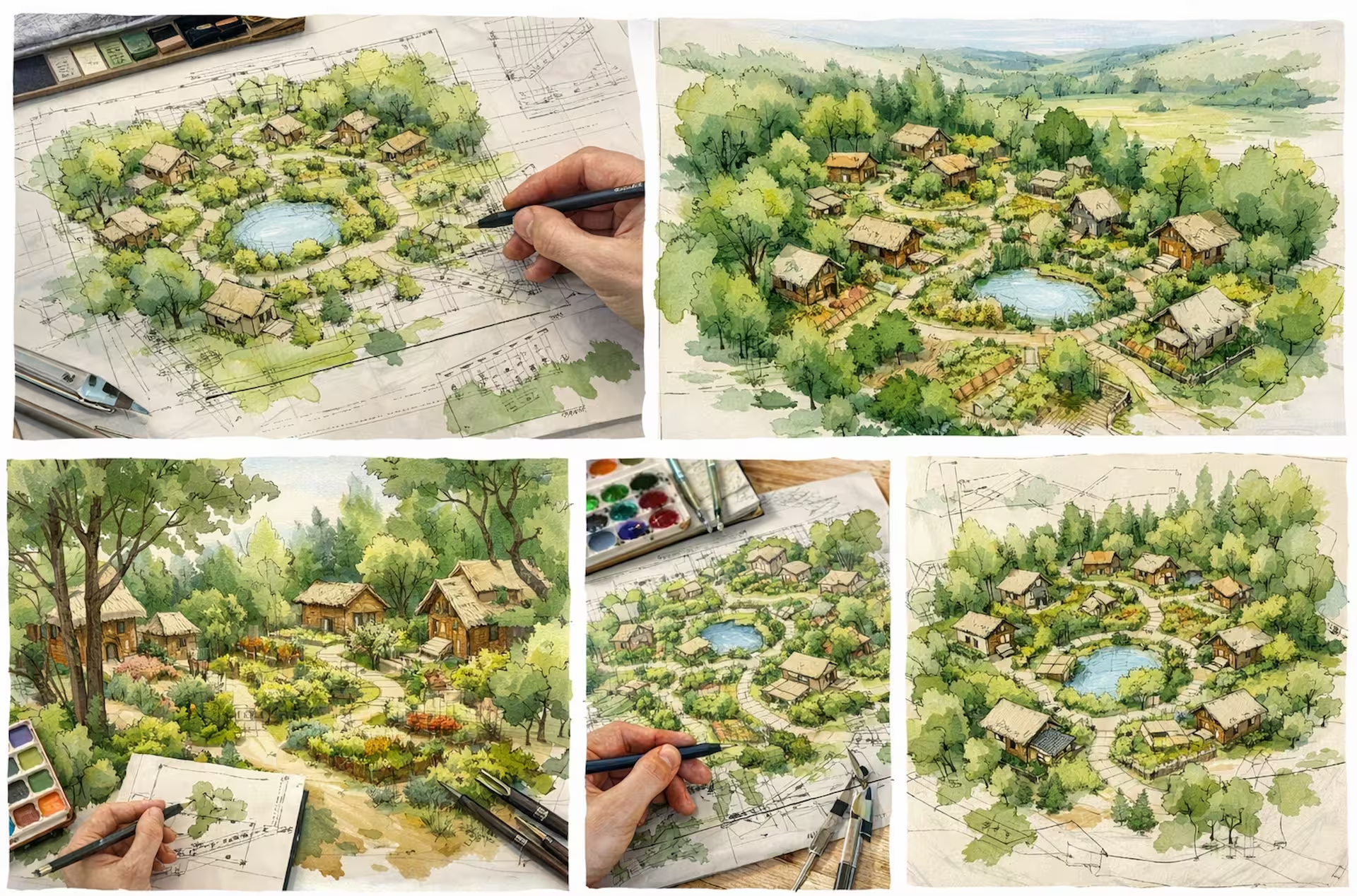
Instead of selling fixed units in predetermined layouts, we built a system that translates constraints and preferences into an evolving plan. It’s not a blueprint, but a protocol.
We Start with Constraints, Not Wishlists. Before any participatory design happens, we define the sandbox: buildable zones, hydrology, solar exposure, access routes and site resources. We establish settlement patterns such as public-to-private gradients, placement logic for shared functions, principles for density and landscape interface. This is non-negotiable expert work. It's where most co-creation projects avoid hard choices and later pay the price.
Then We Capture Structured Preferences. Residents don't draw plans. They specify functional needs (bedrooms, workspace, storage), spatial preferences (quiet edge vs. social center, sun vs. shade), sharing profiles (what they will and won't share such as kitchens, laundry, gardens), and budget bands. Our architects treat each resident configuration as a node in a larger network, map conflicts and synergies between preferences, and resolve these against site constraints and pattern rules.
The Output: Evolving scenarios, not frozen promises. "Given everyone's current preferences, the best-fit pattern looks like X, with these trade-offs." Residents see the impact of their choices on others and on shared assets. Architects get clean, auditable inputs instead of a pile of post-its. Final layouts are expert-led but grounded in a transparent preference landscape.
Why This Matters
This approach avoids two traps: theatre (talk changes nothing) and chaos (every idea becomes a design instruction). It makes participation consequential without making the system unbuildable.
The protocol becomes a learning system that accumulates knowledge across sites and benchmarks what actually works once inhabited. It gets smarter with each deployment.
At Amagi we aren’t just building "another eco-village,” but a reusable operating system for settlements. This design protocol is an asset, a village on Koh Phangan is its first output.
For residents: you're not buying a house someone else designed. You're helping generate the place you'll live.
For the world: proof that we can build settlements that adapt, learn, and evolve.
A Different Kind of Planning
Master plans assume everything can be known upfront. But communities are living systems, not fixed products. They need mechanisms that absorb change and negotiate preferences over time.
Amagi isn't rejecting planning, we're making planning dynamic, participatory, and real. This is how you build places that can actually evolve with the people who live in them.
Building for the long term starts here.
If you believe that the places we live should be as smart and adaptable as the people inside them, stay in our orbit. We share regular insights on generative design, site updates from Thailand, and the evolution of the Amagi protocol.
Join us and become one of the first villagers: Join@amagi.life